
A jar with a village inside it.
Gramyra started in a small kitchen in a small village, with a wooden bilona, a clay pot, and a stubborn belief: that the ghee our grandmothers made was unbeatable, and that there was no good reason for the world to have forgotten how to make it.
Why we do this
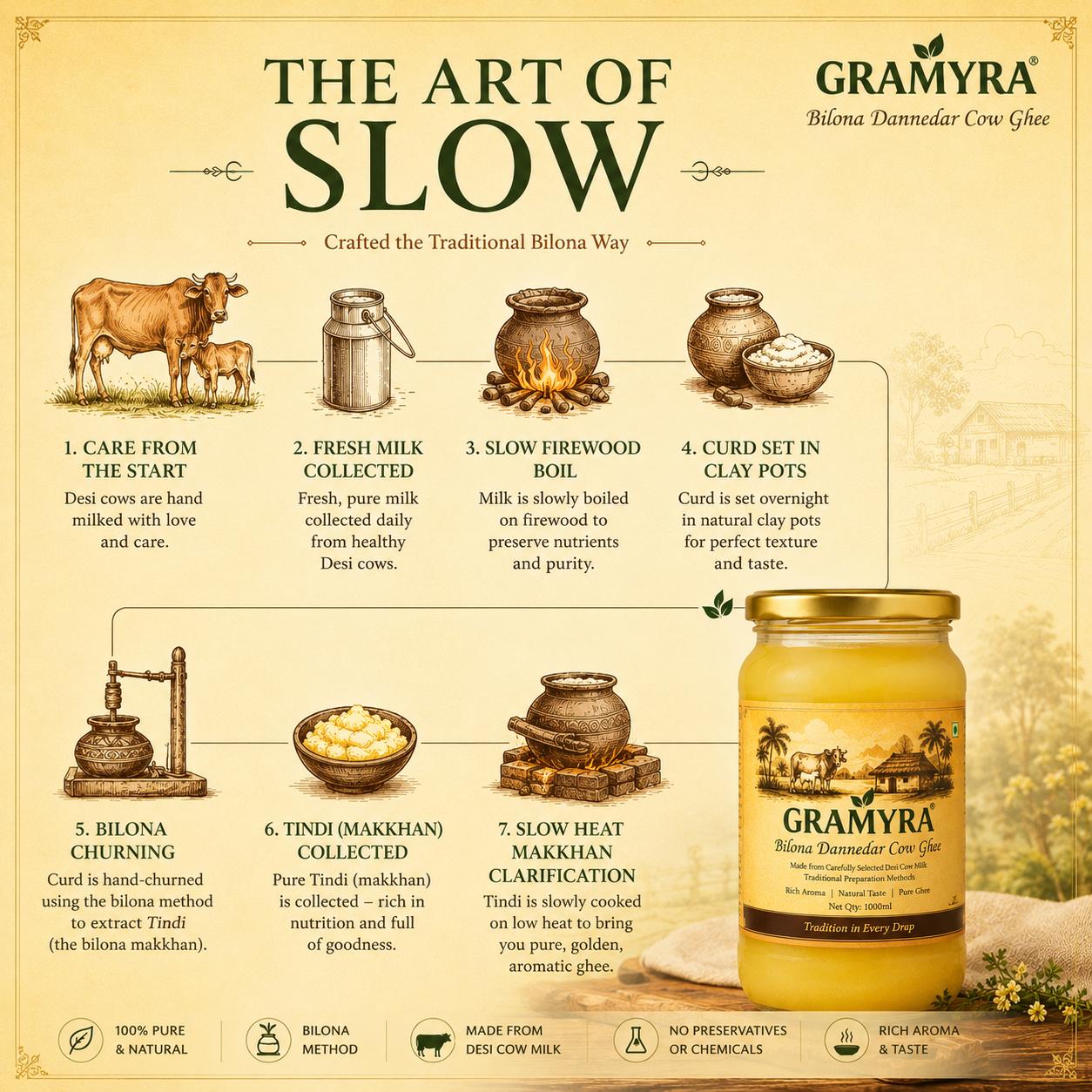
Industrial ghee chases efficiency: cream-cooker shortcuts, mixed milk, plastic packaging. We chose the longer road. Our partner farms keep only indigenous breeds. The milk is set into curd, slow-churned by hand into butter, simmered on a low flame, and bottled warm in glass.
The result is a ghee that smells the way ghee is supposed to smell — toasted, nutty, almost honeyed. The kind a spoonful of which transforms the simplest dal.
Slow. Patient. Worth it.
- 1
Grass-fed cows
We work only with farms that raise indigenous breeds — Gir, Sahiwal, Tharparkar — on open pastures with seasonal greens.
- 2
Cultured and bilona-churned
Milk is set into curd overnight, then Churned in a wooden bilona to separate the butter. No machines, no shortcuts.
- 3
Slow-cooked on low flame
Butter is simmered gently until it turns golden, releasing its signature nutty aroma. We strain, cool, and bottle in glass.
- 4
Lab-tested and bottled
Every batch is independently tested for purity. Sealed warm into food-grade glass — never plastic.